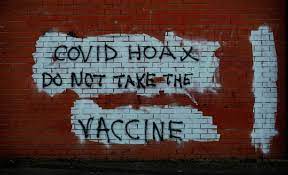
Is this real life? Or is it just science fiction fantasy?
For 18 months, the world we see on our TVs and at the shops has looked more and more, and then less, like what I imagined the real life approach to a pandemic would look like. The movies are always keen to show social collapse, violence over a can of baked beans, and eventual uprising of the everyman who up until now, was just another regular pen pusher whom the viewer knew was capable of something great, because Brad Pitt was playing him. Instead, loo rolls were among the earliest casualties, our messy haired priminister had progressively appeared more and more squiff and while the death count rose and fell, anti vaxers were on high alert, holding kids parties with aggressive smile on their smug faces. I don’t like to use the term Karen, because. I’ve known some nice ones. But we know the type. Anti vaxers have created some hum dinger theories about vaccines. And as someone who’s fiance was diagnosed with autism very early on in life, I know it is a personality type with too many facets to be delivered in a vial.
But the latest pandemic has really brought out the almost militaristic conspirators out and given them a reason to be, and I saw this for myself at, ironically, a wellness event.
On a recent weekend, we visited a wonderful Living Well event in Shrewsbury, a town local to myself. The birth place of Charles Darwin, and I’m sure this is ironic somewhere down the line. There were talks about meditation, Buddhism and yoga, and tents advertising holistic healing practices such as reflexology and sound baths. As someone who loves learning about what others believe and why, while also learning techniques that may or may not help me, I was in my element, and wanted to soak in what I could. So, to the band stand I went for a talk about conscious eating. It was packed. I was approached by a fellow who seemed quite zen, and we started talking. It was then that I realised, when he mentioned protests, that one of us was at the wrong meeting. It was him. They were anti vaxxers and covid deniers, and they were promptly moved on.
This interaction got me thinking for the rest of the day. I would like to think that, had I stayed, what the conversation would have been like, and if they would have taken a bit of counter argumentation. I would love to ask someone why the earth’s governments would lead its economies into despair for the sake of a ‘scam’.
My favorite theory is that with our vaccines, we are being injected with a microchips. These microchips will gather information from us, track our movements, and some other cool things no one feels absolutely hundred percent about. Where are the breading grounds for such ideas? Social media. Anyone else think this is ironic? Yes, I know, I’m overusing the word.
A couple of years ago, I started work for a company that dealt in pensions. During our training, I took away some very valuable information concerning social media. One example was quizzes and questionnaires. We’ve all done them: which Disney Princess are you? What flavour Jelly Bean are you? How many children will you have? To find out this pivotal piece of information, we go through a series of questions like, what is your clothing style, what is your favourite food, where are you most likely to spend your Saturday nights? By the time you get your answer, the companies that created these quizzes know enough about you to target your social media pages with adverts on things you might like, based on your answers. If you answered that you’d spend your Saturday night reading a book because you secretly want to be Belle, don’t be surprised to get shown some great reading material on your feed.
Obviously, any amount of time spent on social media displays the nature of present society; our walls are adorned with memes our friends have tagged us in, parents are often more than happy to share photos and cute videos of the latest adorable thing their little one has done. We check in to bars and exotic sites we visit on holiday, our likes include favourite bands, books and movies. And that’s just Facebook. On TikTok, people share their family members and households, with everything inside, for potentially hundreds of thousands of people to see for the sake of doing some dance challenge (I don’t know TikTok). And all this is done through mobile devices we carry around all the time. We search embarrassing ailments on Google, we buy every day items on Amazon, we date through apps such as Tinder. So my question is, if we were to be micro-chipped, what other information could it take from us? We are track-able as we are transparent. And really, for those who are prepared to share every headache and bowel movement, what more is their left to hide?
Obviously, I’m speaking hypothetically, because that’s all I think anti-vax arguments deserve. Vaccines have eradicated small pox, they’ve paved our path out of this world wide lock down. The suggestions that they turn children gay or autistic (or, at present, robots capable of only thinking what they’re told via a chip beneath the skin) just show the lack of knowledge or awareness of how vaccines, and people, work. It’s understandable to mistrust the vaccines in terms of how quickly they came into existence, but even this can be rectified with an attempt at finding out how vaccine, or any drug, trials work. The vast majority of trials is spent waiting around for paper work to be signed, boards and committees to get to the next thesis in a huge pile of theses (is that right?), for funding, yada yada. This process can take years…unless it’s a world wide emergency. Suddenly, the demand means that the thesis is at the top of the pile and the funding is coming from all corners of the planet. Covid vaccines happened quickly because they were a lot more necessary than the latest new and improved paracetamol. And yet, anti vaxxers continue. In fact, there’s a very good book I do recommend called Bad Science by Ben Goldacre, who delves into the logic (or lack thereof) of how vaccines garnered so much mistrust. In short, all it takes is some unrelated research papers, and a dose of iffy interpretation. It’s shocking, and frankly disappointing, that this decade old book is still applicable to today in this argument.














 Paint a Mental Picture