Uncategorized

The Downside of the News Being Our Only Window to the Outside World

The news has been absolutely miserable (more than usual) for over a year now, for reasons aside from the pandemic. I fully believe that rather than the media aiming to keep us updated and motivated, it has been used as a platform for scaremongering and convincing everyone that the world is far worse than it actually is. When you’re constantly being fed news about the latest riots, deaths and racial battles, do you really want to go out? Or would you rather say home, binge watch a boxset and order pizza to make yourself feel better and avoid the chaos on our screens?

It’s not a new discovery to know that the media cherry picks what it wants to tell you, but there’s still a worrying number of us who will accuse the media of bias, and yet believe it when it shows what they want to see. Case in point; back in 2017 I went to California, and we used Lyft taxis rather a lot. This was still quite soon after Trump became president, and my colleagues actually advised me against going to America due to all the unrest over there. Riots and protests were being shown on every news outlet, but when we got there, I didn’t see a hint of trouble. One of our Lyft drivers, a young black gay actor and one of the perceived targets of Trump’s agenda, was actually in support of him over what rioters there were, and critical of how the country was being shown to the rest of the world. In fact, he’d not seen any riots either.

The thing is, if we see a story reported constantly, it convinces us that it happens much more often than it does. It was the case for the tragic terrorist attack in Manchester at the Arianna Grande concert. It was reported persistently for weeks, and dominated our screens on a daily basis. People started avoiding large crowds altogether. Perceived risk was at an all time high, but actual risk was still at rock bottom.

I also question why the media reports a lot of what it does for any other motive than to frighten. The blood clot scare of the Astra Zenica vaccine, for example. Worldwide news was made because 6 people had been found to have developed blood clots, and these 6 people were 6 of 8 million who had received their first dose. The chances of the blood clot as a side effect was literally lower than the chances of dying on the way to getting the vaccine via car. So why did we need to know that there was a suspected link? We didn’t, not until it was confirmed. As of today, it’s still stated as a ‘possible link.

The thing is, the news reports on the out of the ordinary. If a plane crashes, this rare anomaly will typically be reported for weeks and perhaps months. If there is an act of violence committed by one group to another, it will be reported. If it’s within the group, such as male on male violence? Not so much. Why? Because it’s more common place. But when this is all we see of a world in which we cannot travel to these places ourselves, we paint a picture based on evidence. This creates animosity and outlandish suggestions of curfews for men as a solution to violence against women, or courses for white people to convince them that although they do not actually care what race someone is, they are expected to see race and treat people differently by the same groups who say they want equality. Or a group of people get tarnished with the same brush because one unreasonable person is chosen to represent them on breakfast shows. Generally, we are good, reasonable people who just want to see the world as a better place. But that means interacting, not just witnessing. It means talking to people and learning about their thoughts and opinions, not shutting them down because they’re different to your own. If you don’t want to be friends with them, you dont have to be. If you don’t want to watch the news, you dont have to. If you want to but don’t like what you see, do some research. You might find what they leave out.

Opinion and Advice, Uncategorized

Over-rule Overthinking – How I Learned to Manage my anxiety

Anxiety is one of those things that all of us have experienced, and, when it conflicts with our everyday life, we might get a diagnosis. Social anxiety, generalised anxiety disorder, panic attacks, agoraphobia…. as time goes on, anxiety is becoming more and more commonplace, made aware of, and diagnosed. I’ve suffered with anxiety for most, if not all, of my teenage and adult years, and while I’ve never been diagnosed with anything, I don’t need a weatherman to tell me it’s raining, and I let it stop me doing what I wanted for a large portion of my life.

One particular incident that sticks in my mind is being scared to go to school. I had no reason to be, but I was at home in my living room staring at the front door, in tears. It was completely random, and probably happened three times during my whole time at secondary school. Another time was when I had a panic attack at the front of class during a presentation. But I’ve discussed my fear of public speaking before.

So how do you get out of letting anxiety rule you to the point of not going out, simply because your heart races at the very idea? Anxiety and panic manifests in so many different scenarios for people; going to class, going to work, before a big life event like a wedding, or when confronted by the very thing we are most afraid of without really knowing why. The key is to confront your fear, but in a measured, structured way. Of course, this process is different for everyone. It might be a case of defining a list of what we’d like to achieve and working through each item, step by step.

First and foremost, anxiety is defined by worry, panic and negative thoughts. The typical cycle begins with a event, that typically triggers a negative thought and that leads to a feeling. Often this will lead to us fearing similar events. One example might be to be among work colleagues, and you say something; maybe it was a joke that no one laughed at, or you stated a fact and were told you were wrong. I use this example because I used to be terrified of saying something wrong incase I was seen as stupid, and would get flustered any time I was ever even responded to. In this case, you might get embarrassed, you heart might beat hard and your palms become sweaty. Later that night it is likely to run around in circles in your head like an old film on a loop.

So How Might You Break Out of this Behaviour?

1. Narrow down your fears – it can be easy to let your anxiety bleed into everything you do. Fear of social situations can cause one to become scared of going out in general, even to the local shop. Anxiety in the form of phobias can have a huge impact on whether we go out to certain places. If someone is scared of heights, this may greatly diminish the likelihood of boarding an aeroplane. But where does the fear stem from? It might be such a long standing fear that it might be impossible to tell, but consider instead what makes you anxious about these situations. Do phone calls make you nervous? Why is that? Is it because you’re not able to see the facial expressions of the other person? If you scared of dogs, can that be rooted to an experience?

2. Separate rational from the irrational – the most known definition of a phobia is an “irrational fear” of a situation or object we might come across in our every day life. Now, there are so many different phobias around now that it’s impossible to know what all of them are. Some, I believe, are fully rational. Fear of heights, blood and confined spaces are all rational in my opinion, because they all present a real danger. Not all fears are to be overcome; anxiety is an evolutionary technique of self preservation to keep ourselves safe, and if we perceive something as being dangerous, such as a large spider, while it might pose a real threat to ourselves if we don’t live in countries like Austrailia, it is there for a reason.

3. Set your boundaries, and respect them – don’t do anything you don’t want to do, but if you have to, work up to it. This might be meeting with a large group of friends as an end goal for someone with social phobia. Start with a phone call with a friend, or perhaps a video chat. You’re in your own comfortable space, in your own comfort zone, and you can leave whenever you like. If you need to, have a reason to leave prepared. Maybe the doorbell went, or you have something cooking.

4. Talk, and listen – anxiety is far more common than anyone might think. The cruelty (and the saving grace) is that everyone has experienced anxiety, and its highly isolating effects. It’s so easy to feel alone during a panic attack, and we might avoid potentially helpful experiences in case they trigger one. But talking can help, if you’re talking to someone who’s willing to be open about it. Thankfully all of my friends, close family and fiance have all had experiences with anxiety that have made them open about it, because they know. They know the value of talking about it, of describing each feeling and why they felt it.

5. Challenge yourself – once in a while, you’ve just got to think, well, fuck it. My big step was going somewhere alone. I really tried with the cinema, but try as my logical mind did, I still pictured being the only tragic person alone watching The Phantom Thread at Cineworld in an empty auditorium, a single shadow. So on that day, I figured I’d do something else equally daunting, and potentially more empowering; going for lunch in a restaurant by myself. I had my book, it was wonderful. The weather was lovely, I had no rush in me because I had a half day at work. Bliss. I couldn’t be stopped after that until…well, you know. And by the way, if anyone if unentertained enough by their eating companion to notice and judge you for being alone, don’t worry. They’re most likely envious that they haven’t got the confidence to do it.

6. Recognise the benefits – there are far more benefits to breaking free of the restricting habits. But, of course, the safety of the cocoon anxiety nets around us leaves us at little risk of danger. In this cocoon, we cannot make a fool of ourselves, cannot say the wrong thing, and probably wont have a panic attack unless we think really hard about the toll anxiety is having on our lives and our mental wellbeing. But to break out of that let’s you become more aware of your strengths and that, despite your worries, you were still able to make the push outwards.

Ways I Conquered the Rule Anxiety Had

1. Going for lunch alone

2. Going to lectures and library talks alone

3. Going on holiday without my parents (I have an absolute conviction every time I line up for check in that I’ve arrived on the wrong day).

4. Taking charge of meals with friends and family by booking myself.

5. Making phonecalls

6. Going to London alone

7. Presenting an idea to my workmates before I had time to get nervous and didn’t say a thing
artwork, Uncategorized

Things I Want to Say to Artists on Social Media

Social media can be great, but it can also be toxic. Pointing out the obvious, I know. But I have a specific reason for that. As an artist, I know how easy it is to get sucked into the world of follow for follow and what not. This is my second post on this topic, because really it just makes me sad to see people burn themselves out chasing likes, follows and fame.

The truth is, there’s a sad reality around being an artist on social media. And it’s this; for every artist who gets recognition, there’s hundreds who give up on their craft, or their aspirations to be a good or great artist, because they think no one is paying attention to their work. They think, “if no one likes my work, this means I’m no good,” or the like. This is not the case. I’m going to be blunt here, I’ve seen many great, skilled artists with very few followers on Instagram, while those with limited skill have thousands. I myself have under 300, and this used to bother me.

And then, the other day, I saw on Facebook someone griping about not being able to get above 750 followers, because people followed and unfollowed days later, and so posted her link on a few art pages for people to follow. This was responded to with the dreaded ‘follow for follow’ requests.

Now, I think what her problem was was that each person who unfollowed was formally expecting a follow in return, and so stubbornly clicked that button in protest. So many artists want something in return for their simple click of a button, and that is how it has become such a powerful action, the difference, for some, between having a day confident of one’s skill, or thinking you’re a failure because not enough people liked your latest post.

But I’ve being thinking about this during this pandemic. Afterall, if anything it has been a time for reflection, where social media has become such a prized tool for networking, what with an opportunity for small businesses to potentially thrive in the face of mass store closures. Drawing may be your income, but for those of us who just like to create, where do you draw the line?

This is how I see it;

1. Being an artist is often about reciprocation ; you’ll get a follow or a like because people like your work. Sometimes, however, it’s because they want your likes and follows in return.

2. If you draw for likes, you’re not creating for good reasons ; drawing is such a sharable, useful skill. But what is the point in doing something that ought to be relaxing, inspiring or just something that is meant to bring you joy, if you’re going to get stressed and miserable over it instead?

3. Stick to what you’re good at ; some people can pluck an idea out of their head, and put it to paper. Others can replicate a face directly with pencils. But if you have a niche, no matter how obscure it is, that will bring you much more happiness than attempting a shareable fan art piece of the latest movie character you probably don’t care about.

4. Think about turning art into your income; really think about it. Drawing day in and night out might sound like a tremendous gift, but do you really want to turn something you love into a chore? I remember when I was fourteen, having started my GCSEs at school, and I chose media instead of art. I was told this was stupid numerous times because, for me, they thought art would be an easy win. Even one of my teachers told me I wasted a GCSE. But I also love film, and thats why I chose media studies. It wasn’t wasting a qualification in anyway, and if anything, I feel I love my skill more because I have a choice in it. But customers, in short, can be crabby. Most are delightful, don’t get me wrong, but you also get the ones who don’t understand that a drawing is an interpretation, not a print out. Drawing is a honed skill with a person’s hand doing it, not a soulless computer. It takes time, resources and confidence to put yourself out there, and confidence can shatter just like that.

I’m not trying to put anyone off. In fact, I’m trying to be that pragmatic person who wants artists to keep loving what they do. If you don’t get so many likes as you thought you would, that’s okay. Van Gogh was questioned, doubted and insulted for his percieved lack of skill, and today is arguably the most celebrated artist of his generation. There’s so many of us now, and so much talent out there. Talent shouldn’t be wasted on shallow things such as likes.

lists, Uncategorized

Are To Do Lists the Death of Productivity?

If you have read any of my earlier blogs, you would know that I love a good list. Or, at least, loved. They’re organised, neat, and just creating one can give you a sense of productivity and control. A list represents order, allotted time for certain tasks.

But there’s another side to them, too. Lists can show you how much you have to get done, how much you think you have to do, just to complete the list. If you’re the way I was, an incomplete list is like having an altogether unproductive day. For me, having just one item left, forgotten about or pushed back until the end of the day, was both frustrating and daunting. If i’m honest, it was usually my 10 minute session on Duolingo, learning some French I probably wouldn’t remember afterwards. If I did it, it was the bare minimum, but it counted, didn’t it?

Not necessarily.

I can’t remember the last list I made. I haven’t abandoned them altogether mind, and that’s not what I’m suggesting. But really, what does a to do list contribute towards getting all that necessary, and unnecessary, stuff done? Because I’ve found that not tying myself to a task not only makes me more productive, but it also leaves me much more free time.

So this year I made a dreaded, apparently doomed to fail new years resolution. Doomed to fail because, beyond the first couple of weeks of January, aren’t resolutions doomed to fail by simple self fulfilling prophesy? I think people make them sometimes just to fail them, and then they can laugh about it later about how naive they were, how hopeful they began the shit storm of a year behind them (for some people, no matter what happened in that year, it’s inevitably going to be branded a shit storm.). There’s almost a culture being created around choosing drinking wine in place of a workout and moaning about the shape of the globe on Facebook. But anyway, I digress. Where was I?

Oh yeah, lists.

So I made a resolution to start learning guitar. Properly, this time. A few of my friends have done it, I started back when I was 14. Despite owning three guitars, one of which I made myself, I never could remember a single chord. I tried to stick to this resolution last year, too, but alas, apparently a pandemic gives you copious amounts of time, but its not always paired with motivation. Usually, I would look at the item on my list marked ‘guitar practice’ and pass it off as unimportant. I’ll do more tomorrow.

Now that I don’t make lists, I not only get to practising every day, but I remember more too. And this hasn’t just been the case for guitar. I decided to start learning Spanish on Duo, and I’m on my 31 day streak. I draw more, I read more, I’m more organised in my yoga and running (every Monday, Wednesday and Friday) and still manage to keep the apartment tidy, my bearded dragon alive and set aside more hours than I’m happy to admit on the internet to binge watching Supernatural. I’m not humble bragging (okay maybe just a bit, but now that I meditate I think the smug bug has got me just a tinsy bit) but I think this just shows how unessential lists are. A list can organise your time, but they can also create chores out of things you ought to enjoy. Hobbies are there for exactly that. Enjoyment. And as for cleaning, am I wrong for enjoying this too? It’s a part of life, we might as well make the best of it.

My point is, there comes a point where you’re doing things not because you want to, but because you feel like to have to. It’s exhausting, and its not as productive as you think. If you want to do it, do it. But you don’t have to. And don’t be scared to have a nothing day. Brains get tired, you know.

Uncategorized

Should Celebrities Be Punished More for Breaking Covid Rules?

Is it just me, or do people get more idiotic as the pandemic goes on?

I get it. We’ve been in this situation for going on a year now, and in some ways it feels like we are further away from coming out of it. Even with vaccines, the fourth just being announced, we are still a very long way from normality. And the longer we go, I guess the more tempting it is to just break a rule. Travel a bit further, meet a friend, hug a relative. And yet, so many of us haven’t. So why do so many think themselves above the rules?

For a few months now, £10,000 fines have been handed out left right and centre. From house parties to outdoor raves in abandoned train station tunnels, private funerals to 400+ strong weddings behind blacked out windows. But for some reason, famous people breaking the same rules just feels that bit more infuriating.

My prime beef is with the situation of Rita Ora’s 30th birthday party. We all know the story; 30 guests to a pricey upmarket restaurant in London, which was at the time a Tier 3 zone, which prohibited such gatherings. This happened weeks ago, but over the last couple of days police have issued further information concerning the set up of this party. Apparently, Rita Ora’s ‘team’ offered the restaurant £5,000 to open the restaurant and hold this private gathering, during which CCTV cameras were switched off (I believe, I know they were done to not capture the festivities, I’m a lousy researcher, and who has the time anyway?) and curtains blacked out the windows. When the police alerted the guests inside, they all fell quiet. Clearly behaviour of those being caught out.

So why is this so much more infuriating to me? I don’t think I’m alone in this either. The fact of the matter is, Ora was able to spend £5,000 just to ask this restaurant owner, who’s business had no doubt taking a hit in earnings, as so many other business have, to open this venue. The fine, which she so graciously offered to pay, was £10,000. Is that fair? This kind of fine might financially cripple so many, but I have an incling that £10,000 is not such a big deal to her. With numerous promotional deals for business ongoing, a new brand of tequila out, and a role in a frankly god awful looking film (yes, I love Oliver! and just let me have my rant) is she really regretful of her choices from an earnings perspective?

So this raises the question; should celebrities be punished more for breaking the rules? In short, I say yay. The fact of the matter is, she is a public figure. So many politicians have lost their jobs over travelling a long distance or going to pubs, partly because of their public image. As for the general public, their mistakes cost them an eye watering fine, potential naming and shaming among relatives, and maybe even blurred out footage posted online. This could be damning to anyone, and that’s why I think standardising the fine for everyone to one amount is unfair. I think a celebrity, a high earning public figure with a thriving career in multiple forms and a large following ought to pay a higher price.

Instead of a standard £10,000 fine, the fine should be worked out in a similar way to tax. A 5 or 20% cut, say, of their annual earnings for that year. Perhaps it should be donated to help towards the covid efforts, PPE and extra staff and all that. I also think that promotions of their own products should be suspended for a period of time. I think they should be held accountable for their actions, and maybe even throw a bit of suspended social media activity. Years ago, that would have sounded like grounding a teenager for staying out too late. Today, so much is achieved through apps such as Instagram, TikTok and Twitter, that it’s become a viable tool to become famous, and keep getting more famous.

For everyone, I don’t think it’s enough to issue adverts of radio asking us if we can look someone in the eye and lie about our adherence to the rules. Instead, I think it should warn those breaking the rules to such a brazen degree that if you choose to break them , no matter who you are, you are wilfully giving the powers that be permission to use your photograph and name and share your identity as one of the few who are potentially keeping us all in this mess. That they were contributing to the spread of a virus that has prevented people from meeting loved ones, from comforting a relative in their last moments, from celebrating life events in the way that they should be celebrated.

I think that if people feel their name, popularity and reputation is threatened, they are much more likely to comply than if they are told that people will die. Sad, isn’t it?

Uncategorized

What is Actually Wrong With Love Actually?

I love ‘Love Actually’, actually, to quote Kitty from Ghosts. British romcoms just have that thing about them, from my totally biased British opinion. They are cosy and unrealistic and feature a barrage of clumsy bumbling characters. Usually featuring Hugh Grant if you’re thinking of a certain time period for British romcoms. But yes, I love them. I love the stiff upper lip awkwardness, the double entendre, and yes, there are plenty of stereotypes. But movies have stereotypes. And, and this is my main point, movies are fictional.

You’ve probably seen the following kind of article lately. I watched this and I have questions. I watched that classic film and I was horrified. I’m watching love actually for the first time and it’s AWFUL!!! Yes. We get it. It was made in 2003 and you’re super offended by its lack of 2020 standards (and “oh the Andrew Lincoln scene is just creepy”). But is it that bad? I don’t think so. In fact, there’s so many good things about Love Actually that these people don’t seem to realise. The smattering of jokes unique to British humour. The singing priminister’s guard, the irony of a pair of movie body doubles struggling to ask each other out. Emma Thompson’s acting. References to the passengers aboard the planes of 9/11.

The scene between Keira Knightly and Andrew Lincoln is still my favourite scene. As he mentions, he’s confession to provide an explanation, clear the air. Not with any other motives. “With no agenda.”

The criticism around Love Actually and other films of the like, such as Four Weddings and a Funeral, has increased in the last year or two. The key criticism being too straight, or too white. As I say, we are not in the time we were. As for Four Weddings, in my opinion, it features one of the most modern and respectful depictions of a gay couple, even by the depictions used today (such James Corden in that Netflix film… Prom, is it?). In a sea of incorrect and potentially hurtful stereotypes of gay men, we saw a couple that weren’t characatures for cheap jokes. We just saw a couple, the only couple among that group of romantically unsuccessful friends, fully accepted by all.

We need to edge away from the idea that all movies need to depict social issues, need to shoehorn characters in for the sake of diversity. So many films focus on one group of people, and yet today there seems to be this pressure to feature as many racial, cultural and LGBTQ groups as possible into mainstream movies. So much so that it deviates from a true story. Love Actually may have its issues when viewed from the lenses of today, but it wasn’t made for that. It was made for audiences of then. Movies used to be made for escapism. To reflect technological advances. To tell a story. Today, even in a fantasy or a superhero flick, we are being reminded of social issues and imbalances. In the time we are currently in, do we need to be reminded in the evenings too that the world isn’t perfect? Do we need our TV shows to preach to us in a time of what we want to use for relaxation and switching off?

Yes, some movies should be made to deliver a message. But other movies can simply exist to have fun with. To watch when we just want to feel warm and fuzzy, or cry like no one is watching. What, I ask, is wrong with that?

Uncategorized

Judging the Past by Today’s Standards – A Rant

So its time to put this particular rant in writing. I think I’ve bored enough of my family enough with it, but alas. And rants are good. They’re cathartic. And this is one rant that just feels needed.

So I’ve been seeing alot of a particular kind of article recently. More so in the last week. ‘I watched this for the first time and now I’m shocked’ type discussions, in which someone (often around my age) watches a classic film or TV show and is super offended by its outdated jokes and content (‘On the Buses’ I get, but that was an extreme case). The most recent one was about someone watching the first episode of one of my favourite shows, Only Fools and Horses. Straight away, it was racist, sexist, and how dare they focus on three white men. Look. That was the time. The time now is different. The time now is different because of shows like this. We know time is different now because we have shows like this to compare it too. Yes, some jokes were made back then that haven’t aged well. But there were jokes made in shows 10 years ago that haven’t aged well, either. We are in the midst of a huge shift in standards, and thats a good thing. But does that mean we should delete the things that remind us how far we’ve come?

I’ve also seen some wilful fabrication of TV show content in support of the BLM movement. One fine example was concerning a show called Benidorm, in which there was a character in black face during the second episode. Apparently, one of the central couples walked out in disgust, and it was supposed to be a poignant point concerning how offended one of the characters was. But no, that didn’t happen. The couple who actually walked out of a bar was a totally separate couple walking out of a completely different bar due to a very different act.

I think context is a huge factor in some jokes, particularly in classic comedy and content. To get the jokes, sometimes you need to know the characters. Case in point; Basil Fawlty, and The German’s episode. Now, this character is meant to be unlikeable. He’s meant to get in his own way. He’s bigoted, he’s old fashioned and outdated. He’s meant to contrast with the more current characters. To be prejudice is part and parcel of the characature of a middle class man who clearly wants to be higher up in the ranks, but doesn’t go about getting there in the best way. The fact that he recoils from a black doctor in the presence of his embarrassed wife just goes to show his worst traits; in the 70s, shows such as Love Thy Neighbor purposefully created unlikeable white characters to contrast with likable black characters to show the changing times. It was progress.

And this is why old comedies like this should still be valued. Shows as recent as Friends, with an all white principle cast, are products of their time. The shows we have today are products of this time. We should be proud of that progress. Not repulsed by past jokes.

If we delete these shows, and those old jokes, what have we got to learn from?

Uncategorized

An Overdue Covidiot Rant

Has anyone else rolled their eyes more than normal in the last few weeks? Because I have. And not just in that what are they like the little tykes kind of manner. I mean the, what on earth are you thinking you absolute *very bad word I’m not comfortable saying on the internet* kind of way.

Usually in terms of covid. I know, I know. Covid again. We’re all living it, right? But some aren’t. Apparently, some are immune to the rules. Inject exaggerated quote marks to the word immune. They’re a select minority, but I think that’s why they’re so infuriating.

For a while, I’ve been seeing the terms conspiracy and mind control. Apparently, covid is a conspiracy to keep us under control. I beg the question, how on earth does keeping families apart, urging people not to go and spend their money at restaurants, creating strain for an already stretched national health service, benefit the government or the powers that be? Genuine question. I’d love to hear the rational.

Secondly, two celebrities have been exposed as flouting the rules. On social media. One of them infuriated me more than one. This one was a birthday party. How many people have forgone birthday celebrations, gatherings with families and (sorry to be grim) meetings with dying family members, because of covid? And yet a 30th birthday party goes ahead. Are these people so used to worship that they think outright disregard for rules will just further reinforce their status as higher than us normal folk? Or do they think a shallow apology in which they throw buzzwords out such as ‘misjudged’ will earn pity?

This has been ongoing for the better part of a year. A year, for many. How can you not know how to judge the situation by now?

Uncategorized

Reasons to Create – Besides Views and Likes

When it comes to being an artist, I’m not a fan of social media. If you read my views concerning Instagram and using it to get follows and likes, you probably gathered this already. But, in a climate of so many creaters, its probably crossed your mind once or twice to just down tools, and find something else to do. Or, maybe you’ve been tempted to sacrifice what makes your work unique for something more uniform, more sharable. More potentially viral.

This has happened to too many. Sometimes, a born artist just isn’t a born advertiser of their own work. Maybe modesty gets in the way, or the paranoia that many will say you think you’re better than you are puts you off. For me, self promotion is just a nightmare, and I can’t do it. I can’t be one of those people who sends out their own work to the personal accounts of potential audience members. I tried it once to see how it went, and I just felt like a double glazing sales person.

On the flip side, I also question why being an artist means, to other people, that you should get your art out there. Now, hear me out. I know what you’re thinking, what is the point? What is the point in creating artwork if you’re the only person who sees it, or at most, the friends and family who follow you on your Facebook page?

The thing is, self promotion can be exhausting. I’ve said it before, I think some artists *ahem content farms ahem* but more effort into social media and making sharable content than actually putting effort and passion into their work. Its disheartening to say the least, but you shouldn’t stop.

So why should you keep creating, even if you don’t want to advertise?

1. Its nice to have a talent – I love creating. Its something I’ve always done, and it’s one source of self pride I have when I feel a bit rubbish. Whether it’s painting, sketching or pottery, I’ve always found myself feeling much better after doing something; as long as you like it and feel proud, what else matters?

2. An outlet – creating can relieve stress. Whether its a mindful exercise or just something to take your mind away from something causing you anxiety, having that time away to just make something with your own skill can be highly cathartic.

3. It doesn’t mean you can’t make money – over the last few months I’ve had a few commissions; birds, family portraits, and pet portraits. Sometimes, family can be very useful for singing your praises, and soon the requests start rolling in.

4. Its not how it used to be – one of the most widely used anecdotes artists use to console their lack of sales is that Van Gogh sold one painting in his lifetime, to a man called Julien Tanguey. But we are not in Van Gogh’s lifetime, and now, so many styles and methods are accepted that if Van Gogh were of today’s generation, his success may have been different. Who knows. Its mere speculation. But, again, there’s just so many artists battling for follows, recognition, views… who knows whether Van Gogh’s work would have been so unique and distinctive in today’s climate?

5. It might happen one day, so keep going – as arduous as it might be, if you’re that sure you want to get recognition, then just keep going. Stick to your principles and style, don’t be afraid to try new things if that’s what you want to do. Work up your portfolio, and stay true to yourself. Utilise your imagination. Sometimes, all it takes is one person to stumble across you.

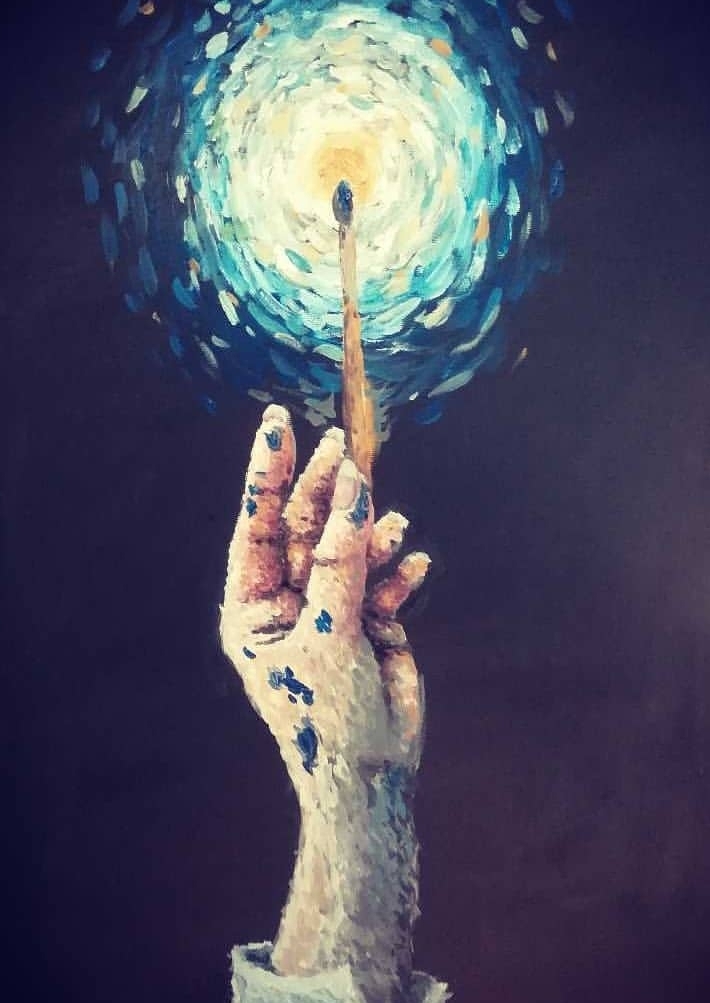
6. You can still inspire – a couple of months ago, I went to London in something I can only describe as escaping. I just felt generally rubbish, and needed a change of scenery, people, all that. One day, I was walking around a very quiet National Gallery, and got a ping through Facebook. Someone had spotted the below painting on a page, and she was asking permission to try and recreate it. It was a lovely moment, and I was more than happy to give permission.